Wix vs Squarespace (2026): Which Is Better for Small Business Entrepreneurs?
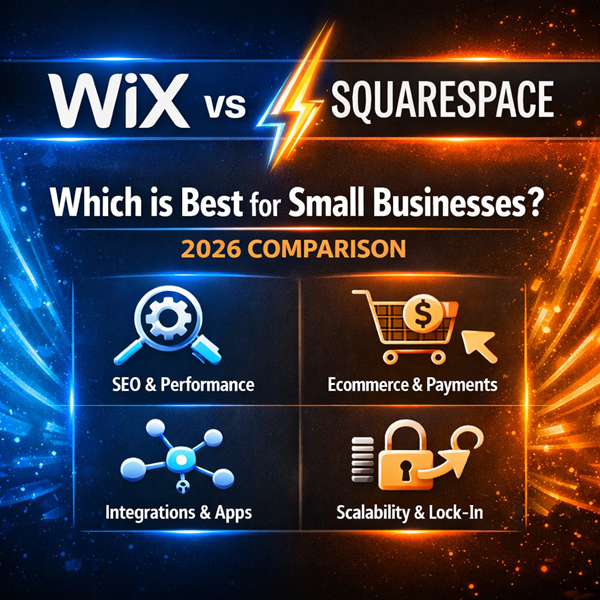
If you are searching “Wix vs Squarespace,” you are likely in decision mode.
You are not exploring what AI website builders are. You are evaluating which platform will support your business long term. Both Wix and Squarespace now integrate AI into their systems, but the real decision is not about AI. It is about architecture, scalability, performance, ecommerce flexibility, and brand control at scale.
This comparison is written specifically for small business entrepreneurs who want clarity before committing.
- If you need the foundational framework behind how AI website builders function, review our AI Website Builder Guide: How It Works and What to Look For
- For detailed individual platform breakdowns, see: Squarespace AI Website Builder Review: Features, Pricing, and Real Limitations and Wix AI Website Builder Review: Features, Pricing, and Limitations
Now let’s evaluate this properly.
Platform Philosophy: Flexibility vs Structured Discipline
Wix operates from a position of flexibility. The AI generates a starting structure, but the editor allows significant control over layout, placement, and expansion. You can add apps, restructure sections, and modify visual hierarchy extensively.
Squarespace operates from a position of structure. Its AI enhances curated templates rather than rebuilding site architecture from scratch. Typography systems, spacing rules, and layout grids are more controlled.
If you prefer architectural freedom and experimentation, Wix leans in that direction.
If you prefer visual consistency and brand cohesion from the start, Squarespace provides that discipline.
That philosophical difference impacts everything else.
SEO Architecture Comparison
For small businesses, SEO is not optional. It drives discoverability and revenue.
Wix SEO Capabilities

Wix allows:
- Custom meta titles and descriptions
- Editable URLs
- Manual heading structure control
- Built-in SEO setup guidance
- Schema integration via apps or manual setup
Wix’s older SEO limitations are largely outdated. Technically, it can rank competitively.
However, because Wix allows more layout flexibility, SEO discipline depends on how carefully you structure your pages.
Squarespace SEO Capabilities

Squarespace provides:
- Clean URL formatting
- Automatic SSL
- Automatic sitemap generation
- Structured content blocks
- Strong blogging infrastructure
Because layout systems are more controlled, heading hierarchy and content structure often remain cleaner by default.
Both platforms are SEO-capable. Squarespace offers slightly more structural consistency out of the box, while Wix allows deeper customization for advanced users.
Execution matters more than brand name.
Performance and Speed Considerations
Performance impacts both rankings and conversion rates.
Both platforms are fully hosted and manage infrastructure internally. You do not control servers, caching layers, or CDN configuration.
Wix:
- Automatically optimizes images
- Uses global CDN delivery
- Performance varies based on layout complexity
Because Wix allows heavy customization, excessive animation or large design elements can affect load times if not managed carefully.
Squarespace:
- Uses managed hosting
- Restricts layout misuse through structured templates
- Optimizes assets automatically
Its controlled environment can reduce user-created performance issues.
For most small businesses, both platforms perform adequately. If you anticipate aggressive customization, Wix requires more active optimization discipline.
Pricing and Plan Comparison (2026)
Below is a simplified annual billing comparison.
| Category | Wix | Squarespace |
|---|---|---|
| Free Plan | ✔ Yes | ❌ No (14-day trial only) |
| Entry Portfolio Plan | ~$16–$18/mo | ~$16/mo |
| Entry Ecommerce | ~$27/mo | ~$23/mo |
| Mid-Tier Ecommerce | ~$32–$36/mo | ~$39/mo |
| Top Tier | ~$59/mo | ~$99/mo |
| AI Included | ✔ Yes | ✔ Yes |
| Platform Transaction Fees | No extra Wix fee | 3% on lower tiers, reduced on higher tiers |
At the entry level, pricing is nearly identical.
The difference becomes more noticeable at higher ecommerce tiers. Squarespace Advanced climbs toward ~$99/month, while Wix Business Elite remains lower.
Transaction fee structure can significantly affect long-term profitability for businesses processing higher sales volume.
Ecommerce Infrastructure and Payment Flexibility
Online payments are central to modern small businesses.
Wix supports:
- Wix Payments (in supported regions)
- Stripe
- PayPal
- Additional regional processors
Squarespace supports:
- Stripe
- PayPal
- Apple Pay (via Stripe)
Wix generally offers broader payment processor flexibility depending on region.
In terms of ecommerce features:
Wix provides physical products, digital downloads, service bookings, memberships, and subscription capability across Business tiers. It also allows expansion through its app marketplace.
Squarespace offers polished storefront presentation, digital products, subscriptions (Advanced tier), and abandoned cart recovery at its highest tier. Ecommerce features are concentrated into fewer but more structured tiers.
If you want modular expansion, Wix offers elasticity.
If you want structured ecommerce progression, Squarespace centralizes advanced tools at the top.
Integration Ecosystem and App Marketplace
Wix maintains a larger third-party app marketplace. This enables CRM extensions, marketing automation tools, niche integrations, and business-specific enhancements.
Squarespace offers integrations but maintains a more curated environment with fewer expansion points.
If your business model may evolve into something more complex, Wix’s ecosystem allows broader adaptation.
If you prefer fewer moving parts and tighter system control, Squarespace feels cleaner.
Exportability and Platform Lock-In
Both platforms operate inside proprietary ecosystems.
You cannot export your full design and host it independently. Some content elements such as blog posts can be exported, but the visual architecture cannot.
If long-term platform independence is critical, neither platform is ideal.
If you are comfortable committing to a managed environment, both provide stability and simplicity.
Brand Control at Scale
As businesses grow, consistency becomes more difficult.
Wix allows deeper customization. That flexibility can empower founders but also introduces the risk of brand inconsistency as teams expand.
Squarespace enforces structured typography and layout systems. That discipline can reduce brand drift and maintain cohesion across pages and contributors.
For founder-led experimentation, Wix offers more control.
For team-based growth and brand consistency, Squarespace provides more structural guardrails.
Final Decision Framework
Both platforms support SEO, ecommerce, AI-assisted generation, and managed hosting.
The decision comes down to how you want to operate.
Choose Wix if you value flexibility, broader integrations, and payment processor variety.
Choose Squarespace if you prioritize structured design, consistent SEO architecture, and cohesive brand presentation at scale.
Neither platform is universally superior. The right choice depends on your operational style and growth trajectory.