AI Website Builder vs Hiring a Web Developer: Cost, Control, and Scalability Compared
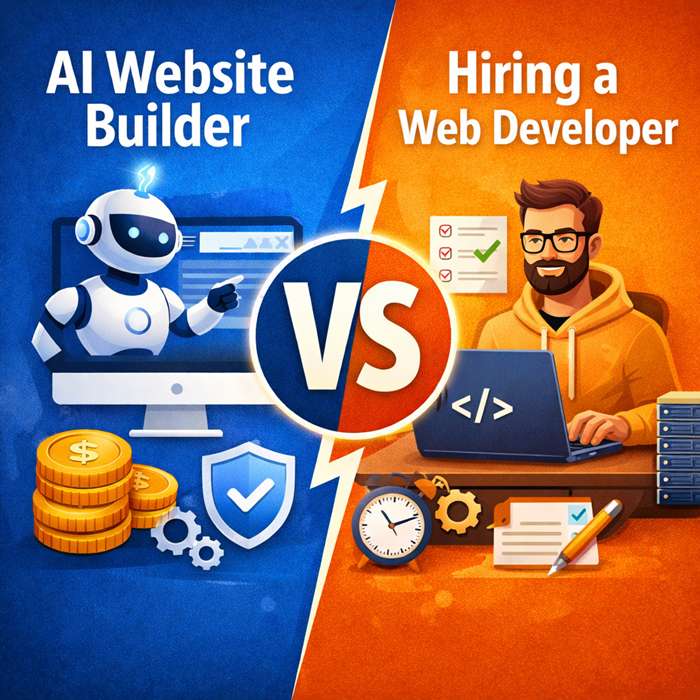
Choosing between an AI website builder and hiring a web developer is not just a design decision. It is a strategic decision about budget, speed, risk, and long-term technical ownership.
Both options can produce professional websites. The difference lies in how much customization you require and how much operational complexity you are willing to manage.
Let’s break this down clearly.
If you want a deeper understanding of how AI platforms actually generate websites — including automation limits and structural tradeoffs — review our AI Website Builder Guide: How It Works and What to Look For before diving into this comparison. That foundational guide explains the mechanics behind AI-generated sites so this decision becomes easier to evaluate.
Overview of Both Options
An AI website builder is a hosted platform that uses automation to generate layouts, structure, and sometimes content from prompts or questionnaires. Platforms like Wix, Hostinger, and newer AI-first builders simplify setup and reduce technical overhead.
Hiring a web developer means working with an individual or agency to build a website from scratch or heavily customize an existing framework. This could involve custom coding, advanced integrations, and performance optimization tailored to your business.
At a high level:
- AI website builders prioritize speed and accessibility.
- Developers prioritize customization and structural flexibility.
Core Differences at a Glance
AI Website Builder
- Automated setup
- Subscription pricing
- Limited deep customization
- Hosting and maintenance included
- Fast launch
Hiring a Web Developer
- Custom build
- Higher upfront cost
- Maximum flexibility
- Requires ongoing maintenance
- Longer timeline
The primary difference is control versus convenience.
Setup and Speed to Launch
AI Website Builder
Typical process:
- Answer structured questions.
- Choose design preferences.
- AI generates layout.
- Edit content.
- Publish.
Time to launch can be under a day.
There is no coordination with third parties, and hosting is pre-configured.
Hiring a Web Developer
Typical process:
- Discovery meeting
- Scope definition
- Wireframes
- Design drafts
- Development phase
- Testing and revisions
- Launch
This often takes 2–8 weeks depending on complexity.
If speed matters, AI builders clearly win.
Cost Comparison (Short-Term vs Long-Term)
AI Website Builder Costs
- $10–$40 per month typical
- Hosting included
- Security included
- Support included
First-year cost is usually predictable and relatively low.
Hiring a Web Developer Costs
- $1,500–$5,000 for basic small business sites
- $5,000–$20,000+ for advanced builds
- Ongoing maintenance or retainer fees
- Hosting and infrastructure separate
Developers represent a higher upfront investment.
The question becomes whether that investment aligns with your business model.
Design and Customization
AI Website Builder Capabilities
AI builders provide:
- Pre-structured layouts
- Responsive design
- Basic branding adjustments
- Standard integrations
They are excellent for:
- Brochure sites
- Service businesses
- Landing pages
- Simple ecommerce
But they are limited in:
- Custom workflow automation
- Complex database-driven systems
- Unique UI interactions
- Advanced application logic
Web Developer Capabilities
A developer can build:
- Custom SaaS platforms
- Advanced ecommerce logic
- API integrations
- Membership portals
- Performance-optimized systems
There is essentially no customization ceiling beyond budget and timeline.
If your website is core infrastructure, custom development may be justified.
SEO and Performance
AI Website Builder
Modern AI builders now include:
- Meta tag control
- SSL certificates
- Mobile responsiveness
- Basic sitemap generation
For many small businesses, this is sufficient.
However, deeper performance tuning and technical SEO adjustments can be limited by platform constraints.
Hiring a Web Developer
A developer can:
- Implement advanced structured data
- Optimize server performance
- Configure caching and CDN layers
- Fine-tune page speed metrics
Performance becomes a strategic asset rather than a default setting.
The difference is not basic functionality. It is depth of control.
Maintenance and Operational Overhead
AI Website Builder
The platform handles:
- Updates
- Security patches
- Infrastructure scaling
- Backups
This reduces operational burden significantly.
Developer-Built Site
You are responsible for:
- Hosting management
- Updates
- Security monitoring
- Bug fixes
Unless you retain the developer, maintenance becomes your responsibility.
If you want minimal technical involvement, AI simplifies operations.
Scalability and Long-Term Control
AI Website Builder Scalability
AI platforms scale well for:
- Traffic growth within normal ranges
- Content expansion
- Moderate ecommerce
However, if you outgrow platform limitations, migration can be complex.
Developer Scalability
Custom-built systems scale based on architecture decisions.
With proper planning, they can support:
- High traffic volumes
- Complex integrations
- Product expansion
Scalability is limited primarily by budget and technical planning, not platform restrictions.
Platform Lock-In Considerations
AI website builders operate within proprietary systems.
Leaving the platform may require rebuilding elsewhere.
With a developer-built site (especially open frameworks), you typically have:
- File-level control
- Database access
- Hosting flexibility
Ownership and independence are stronger in custom builds.
Risk and Validation Strategy
AI website builders reduce financial risk when:
- Testing new offers
- Validating demand
- Launching MVP projects
- Exploring new markets
Developers make sense when:
- Revenue is validated
- Custom features are required
- Competitive differentiation depends on functionality
One approach minimizes risk.
The other maximizes control.
Who Should Choose an AI Website Builder
AI builders are ideal for:
- Early-stage founders
- Solo entrepreneurs
- Service businesses
- Creators launching quickly
- Budget-conscious startups
If your goal is validation and momentum, automation is practical.
Who Should Hire a Web Developer
Hiring a developer makes sense for:
- Funded startups
- SaaS companies
- Businesses requiring custom workflows
- Brands investing in unique user experience
- Companies planning deep technical integrations
If your website is a product, not just marketing, custom development becomes more logical.
Who Might Want a Hybrid Approach
A common path:
- Launch with an AI builder.
- Validate traffic and revenue.
- Reinvest in custom development later.
This reduces risk while preserving long-term growth potential.
Many businesses never need to transition. Others scale into custom solutions when constraints appear.
Final Thoughts
AI website builders and hiring a web developer represent two different philosophies.
AI platforms prioritize:
- Speed
- Simplicity
- Predictable cost
- Minimal management
Developers prioritize:
- Flexibility
- Customization
- Performance control
- Long-term ownership
The right decision depends on your stage, complexity requirements, and tolerance for technical management.
If you are validating an idea or launching quickly, AI tools often make practical sense.
If you are building long-term infrastructure with complex needs, hiring a developer becomes an investment rather than an expense.
The real question is not which option is better.
It is whether your project needs acceleration — or architecture.