What AI Website Builders Actually Do for SEO
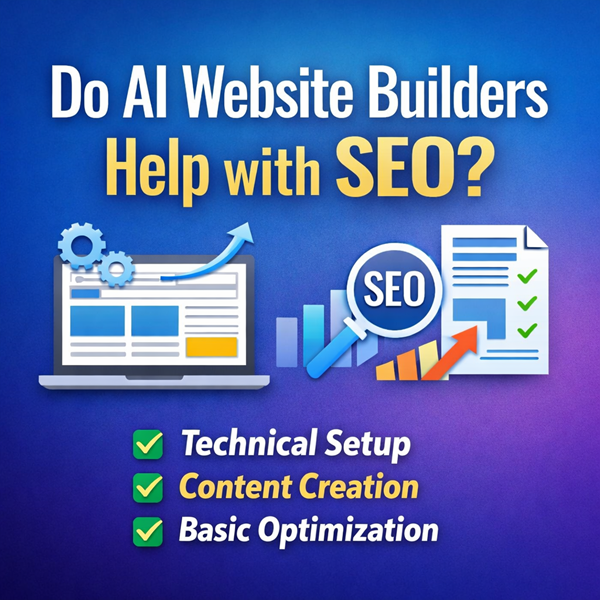
If you are exploring AI website builders and wondering whether they actually help with SEO, the honest answer is: yes, but only in specific ways.
They automate technical foundations. They do not replace strategy.
If you have not read the foundational breakdown yet, start with AI Website Builder Guide: How It Works and What to Look For. That guide explains how these systems generate structure, content, and design. Understanding that framework makes the SEO discussion much clearer.
Now let’s look at what really happens from a search engine perspective.
What AI Website Builders Automatically Handle
Most modern AI website builders are built on managed infrastructure. That means they control hosting, code output, and optimization layers behind the scenes.
In practical terms, they usually provide:
• Mobile-responsive design by default
• SSL encryption (HTTPS)
• Automatically generated XML sitemaps
• Clean URL structures
• Basic meta title and description fields
• Image compression and optimization
• Fast global hosting environments
For beginners, this removes technical friction. You are not configuring caching plugins, editing .htaccess files, or manually validating structured data.
From a foundational SEO standpoint, this is helpful.
Technical mistakes are one of the biggest ranking killers for new sites. AI builders reduce that risk significantly.
Where AI Website Builders Actually Help SEO
There are three main areas where they provide measurable support.
Technical SEO Simplification
Because the platform controls the infrastructure, page speed, responsive design, and basic crawlability are typically handled automatically.
You do not need to understand server configuration to launch a technically viable site. For small businesses and solo founders, that matters.
Structured Page Layout
AI systems often generate pages with logical heading hierarchy. Proper H1, H2, and content segmentation is built into the templates.
Search engines rely on structure to understand content. AI builders usually enforce structure better than inexperienced manual builds.
On-Page Optimization Prompts
Some platforms suggest:
• Keyword variations
• Meta descriptions
• Internal linking suggestions
• Alt text generation
• SEO checklists inside the dashboard
This is not advanced SEO strategy. But it does prevent common beginner mistakes such as missing title tags or empty metadata fields.
For early-stage sites, that baseline matters.
Where AI Website Builders Do Not Help
This is where expectations need to be realistic.
AI builders do not:
• Conduct competitive keyword gap analysis
• Build backlinks
• Establish topical authority strategy
• Interpret nuanced search intent shifts
• Manage content decay and updating cycles
• Replace Search Console analysis
SEO at scale is about authority and intent alignment over time. No builder automates that.
You can launch a technically sound website and still fail to rank if your content strategy is shallow or misaligned.
The builder removes friction. It does not create market advantage.
AI Content and SEO Quality
Many AI builders now include content generation tools. This creates a second layer of confusion around SEO.
The important distinction is this:
Technically optimized content is not automatically high-ranking content.
Search engines evaluate:
• Depth of coverage
• Topical authority
• Internal link architecture
• User engagement signals
• Unique insights
If AI-generated content lacks depth or simply mirrors common information, rankings will plateau.
AI tools can accelerate content production. They do not eliminate the need for editorial judgment and refinement.
AI Website Builders vs Traditional Platforms for SEO
Compared to older website systems, AI builders simplify setup dramatically.
With traditional platforms, you often need:
• Separate hosting
• Manual SEO plugins
• Caching optimization
• Security configuration
• Theme performance audits
AI builders bundle this into a controlled ecosystem.
However, traditional platforms may offer deeper customization, more advanced plugin ecosystems, and greater long-term flexibility for advanced SEO operators.
So the SEO question becomes less about capability and more about scale and control.
For most small businesses, the automated baseline is sufficient.
For highly competitive niches, deeper customization may eventually be necessary.
Who Benefits Most From AI Builder SEO Automation
AI website builders help most when:
• You are launching a new site with limited technical knowledge
• You need to move quickly
• You want technical SEO handled automatically
• You are building a local or service-based website
• You are testing a business concept
They are less helpful if:
• You are competing in saturated national niches
• You need granular technical SEO control
• You rely heavily on complex content silos
• You require advanced schema implementation
It is not about whether AI builders can rank. They can.
It is about whether your growth strategy requires deeper customization over time.
The Real Answer
Do AI website builders help with SEO?
Yes — at the foundational level.
They:
• Remove technical errors
• Enforce structural best practices
• Automate essential SEO settings
• Speed up deployment
They do not:
• Build authority
• Replace strategic planning
• Guarantee rankings
Think of them as reducing friction, not replacing expertise.
If you use them within a clear content strategy and internal linking framework, they can absolutely support organic growth. If you rely on them alone without depth or intent alignment, results will be limited.