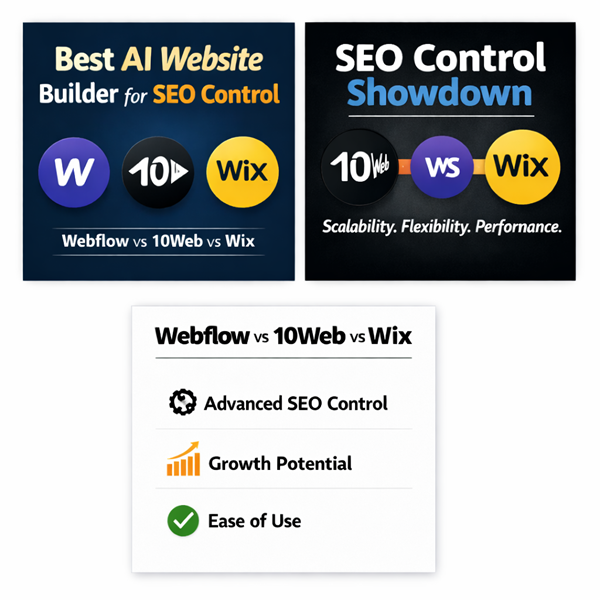
Best AI Website Builder for SEO Control: Webflow vs 10Web vs Wix
If you are searching for the Best AI Website Builder for SEO Control, you are not looking for pretty templates. You are evaluating long-term leverage. You want structural control, performance stability, and the ability to scale content without platform limits.
This article evaluates Webflow, 10Web, and Wix strictly through a scalability and SEO lens. If you need the broader evaluation framework behind how AI builders work, review the AI Website Builder Guide: How It Works and What to Look For before going deeper. Here, we focus on real-world trade-offs for business operators who care about growth, risk reduction, and long-term authority.
Overview of the Three Platforms
Each of these builders approaches AI and infrastructure differently. That difference matters more than the AI branding.
Webflow blends visual design control with structured hosting and increasingly integrated AI features. 10Web builds AI-generated sites on top of WordPress infrastructure. Wix uses a closed ecosystem with AI-assisted setup and simplified management.
At a high level:
• Webflow prioritizes clean code and visual precision.
• 10Web prioritizes WordPress flexibility and plugin-based scalability.
• Wix prioritizes simplicity and managed convenience.
Your decision is less about AI generation and more about how much technical control you need.
Takeaway: platform architecture determines your SEO ceiling.
SEO Control Fundamentals That Actually Matter
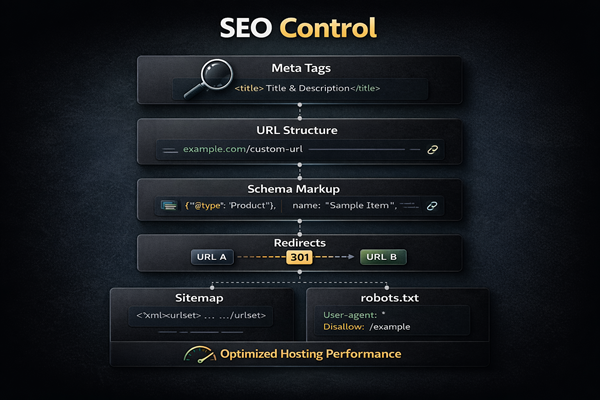
Many platforms advertise “SEO tools.” Few explain what that means structurally.
True SEO control includes:
• Editable title tags and meta descriptions
• Custom URL structures
• Full heading hierarchy management
• Image alt attributes
• Structured data (schema) flexibility
• Canonical tag control
• Redirect management
• XML sitemap access
• Robots.txt editing
• Custom code injection
• Hosting performance optimization
Without these, you operate within limits. With them, you build durable search authority.
Now let’s evaluate each tool against these fundamentals.
Webflow: Structured Control Without Plugin Complexity
Webflow positions itself as a design-first builder, but its real strength is structured output control.
Webflow generates clean semantic code. You can edit meta titles, descriptions, Open Graph data, and structured data manually. Redirect management is built in. Hosting is optimized and generally fast out of the box.
From an SEO control standpoint, Webflow offers:
• Manual schema injection via custom code
• Clean URL management
• 301 redirect control
• Automatic sitemap generation
• Fast global hosting infrastructure
• Strong CMS structure for content scaling
The trade-off is complexity. Webflow requires comfort with structured thinking. It is visual, but not casual. If you misconfigure CMS collections, you can create crawl inefficiencies.
General pricing ranges from approximately $14–$39 per month for standard site plans, with CMS and business plans higher. Ecommerce tiers increase costs further.
Takeaway: Webflow offers serious structural SEO capability without plugin management, but it requires operational discipline.
For a deeper evaluation of real-world usage, see the Webflow AI Features Review.
10Web: WordPress-Level SEO Depth With AI Speed
10Web operates differently. It generates AI-built websites but runs entirely on WordPress infrastructure.
That changes everything.
Because it sits on WordPress, you can use advanced SEO plugins like Rank Math or Yoast. You control permalinks. You control schema at a granular level. You can access robots.txt. You can manage advanced redirects. You are not boxed into a closed system.
SEO strengths include:
• Full WordPress SEO plugin ecosystem
• Custom permalink structures
• Advanced schema configuration
• Robots.txt and sitemap control
• Plugin-based technical optimization
• Hosting tuned specifically for WordPress
The main trade-off is complexity and responsibility. WordPress gives freedom, but you must manage updates, plugins, and potential conflicts. Even with managed hosting, you are operating a more flexible system.
General pricing typically starts around $10–$20 per month for single-site plans, scaling higher for business or ecommerce tiers.
Takeaway: 10Web offers the highest SEO ceiling of the three, but it demands operational awareness.
For a deeper look at flexibility and pricing, review the 10Web AI Builder Review.
Wix: Managed Simplicity With Controlled Limits
Wix has improved its SEO capabilities significantly in recent years. It is no longer the restrictive platform it once was.
You can edit meta titles and descriptions. You can customize URLs. You can manage redirects. Structured data is partially supported. Performance has improved across newer templates.
Wix provides:
• Built-in SEO setup guidance
• Editable meta fields
• Redirect manager
• Automatic sitemap generation
• Structured data templates
• Fully managed hosting
However, Wix remains a closed ecosystem. You cannot access server-level configuration. Schema flexibility is more limited than WordPress. Advanced technical SEO customization is constrained.
General pricing ranges from roughly $16–$32 per month for core business plans, with ecommerce tiers higher.
Takeaway: Wix reduces complexity and risk for non-technical operators but limits advanced SEO architecture control.
Core Differences at a Glance
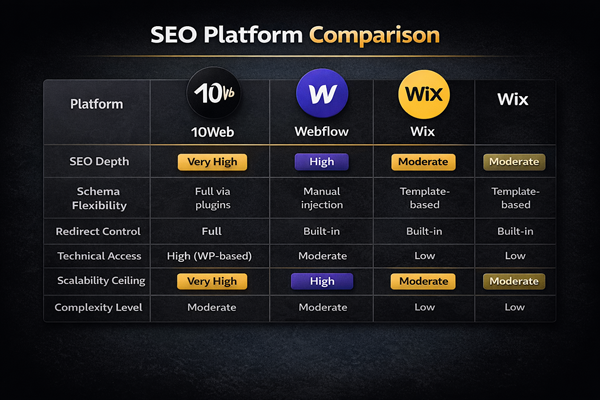
Here is a structured comparison focused on scalability and search control.
| Platform | SEO Depth | Schema Flexibility | Redirect Control | Technical Access | Scalability Ceiling | Complexity Level |
|---|---|---|---|---|---|---|
| 10Web | Very High | Full via plugins | Full | High (WP-based) | Very High | Moderate |
| Webflow | High | Manual injection | Built-in | Moderate | High | Moderate |
| Wix | Moderate | Template-based | Built-in | Low | Moderate | Low |
This table reflects structural control, not marketing claims.
Takeaway: 10Web offers the highest control ceiling, Webflow balances control and managed hosting, Wix prioritizes ease.
Scalability Considerations Beyond SEO
Search authority requires scale. Scale requires infrastructure.
With Webflow, CMS collections allow structured growth, but large-scale content projects require careful planning to avoid complexity creep.
With 10Web, scalability mirrors full WordPress capabilities. You can expand categories, custom post types, and advanced SEO strategies without artificial platform ceilings.
With Wix, scaling is simpler for small businesses but less flexible for advanced content architectures or affiliate-style expansion.
From a cost perspective:
• WordPress scaling may increase plugin and hosting complexity over time.
• Webflow scaling increases plan costs and CMS management demands.
• Wix scaling remains predictable but limited in structural flexibility.
Takeaway: evaluate scalability over a three-year horizon, not the first six months.
Risk Sensitivity and Platform Lock-In
If you are risk-aware, platform lock-in matters.
Webflow allows export of code but not full CMS functionality portability. Migration can be complex.
10Web, being WordPress-based, offers the highest portability. You can migrate hosting or change providers while retaining your content and structure.
Wix has the highest lock-in. Migration away typically requires rebuilding.
Takeaway: if long-term flexibility and ownership matter, WordPress-based systems reduce platform risk.
Fit-Based Recommendations
Choose 10Web if:
• You want maximum SEO customization.
• You plan to build topical authority at scale.
• You are comfortable managing WordPress infrastructure.
• You want reduced long-term lock-in risk.
Choose Webflow if:
• You value structured design control.
• You want strong SEO capability without plugin management.
• You prefer managed hosting with serious flexibility.
• You are comfortable learning a more structured interface.
Choose Wix if:
• You want simplicity first.
• You are building a small business site with moderate SEO needs.
• You prefer a fully managed environment.
• You want predictable maintenance without technical involvement.
Takeaway: match the platform to your operational tolerance, not just your SEO ambition.
Final Assessment
The Best AI Website Builder for SEO Control depends on how far you intend to push your search strategy.
For maximum structural authority and long-term scaling, 10Web provides the highest ceiling. For balanced control with cleaner visual management, Webflow is a strong middle ground. For ease and simplicity with reasonable SEO capability, Wix is suitable but capped.
Your decision should reflect where you expect your business to be in three years, not where it is today.