Hostinger AI Website Builder Review: Features, Pricing, and Real Limitations
Introduction
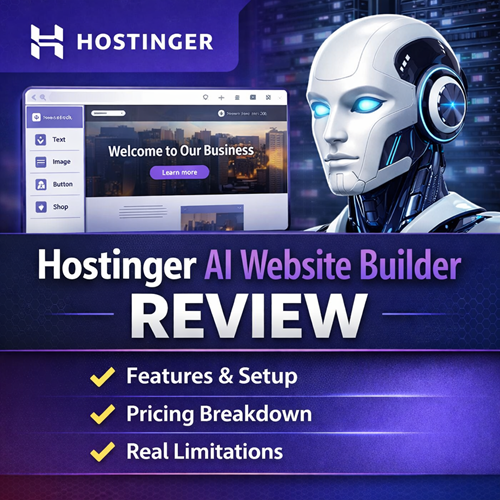
The Hostinger AI Website Builder is designed to simplify website creation by combining hosting, AI generation, and a visual editor inside a single subscription. Its appeal lies in reducing technical decisions and accelerating launch timelines for non-developers. For many small businesses, that promise of speed and simplicity is attractive.
Before evaluating this builder in isolation, it helps to understand how AI website builders function structurally. If you have not yet reviewed the foundational guide. That broader context makes it easier to assess where Hostinger fits within the larger AI builder landscape.
This review examines usability, customization depth, SEO capability, ecommerce features, pricing structure, and long-term scalability in practical terms.
Platform Overview

Hostinger’s AI Website Builder is not a standalone application but part of Hostinger’s broader hosting ecosystem. When you subscribe, you are purchasing infrastructure, security, and editing tools in one bundled system. This integrated model removes the need to configure third-party hosting or manage plugins separately.
The platform is intentionally closed and controlled. That design decision simplifies management but limits flexibility compared to open CMS platforms. Users operate inside predefined structural boundaries.
• The bundled infrastructure means you do not have to configure hosting separately, which reduces setup complexity.
• The closed ecosystem ensures stability but restricts advanced customization options.
• The integrated environment simplifies billing because all services are contained within a single subscription.
This structure is optimized for ease rather than deep technical control.
Setup Experience
The onboarding process is streamlined and built for beginners. Users provide basic information such as business name, category, and a short description of services. Based on these inputs, the AI generates a site draft that includes layout, navigation, color scheme, and placeholder content.
While the draft appears complete, meaningful refinement is still necessary. Editing headlines, improving messaging clarity, and aligning branding elements requires deliberate effort. The AI eliminates the blank-page problem, but it does not replace strategic positioning.
• The initial draft is generated quickly, often within a few minutes of answering setup questions.
• Customizing the generated content requires thoughtful editing to ensure clarity and differentiation.
• The streamlined flow reduces technical friction, making it accessible for first-time website owners.
Overall, the setup process prioritizes speed and simplicity.
Editor and Customization Depth
The drag-and-drop editor allows users to modify sections, images, text blocks, and layout elements without coding knowledge. The interface is clean and controlled, reducing the risk of breaking site structure. For beginners, this environment feels intuitive and stable.
However, deeper backend customization is limited. There is no plugin marketplace or advanced architectural modification capability. This means structural changes beyond predefined templates are restricted.
• The visual editor allows meaningful surface-level customization without requiring technical skills.
• Advanced design systems or complex structural logic cannot be implemented within the platform.
• The absence of plugins reduces complexity but also limits expansion potential.
The customization experience is balanced toward safety rather than flexibility.
Design Quality
Hostinger’s templates are modern, responsive, and aligned with current web design conventions. The AI-generated layouts typically include clean typography, structured sections, and mobile optimization. At first glance, most sites built with the system appear professional.
However, template similarity is noticeable across projects. Without significant manual refinement, websites may lack differentiation. Brand identity must be carefully developed within the system’s structural boundaries.
• The mobile responsiveness is built in, which ensures baseline usability across devices.
• The design language emphasizes clarity and readability over experimental creativity.
• Meaningful differentiation requires thoughtful branding adjustments beyond default settings.
The design output is polished but standardized.
SEO Capabilities
Hostinger includes essential SEO functionality such as editable titles, meta descriptions, and customizable URL slugs. SSL security and mobile optimization are handled automatically, which supports baseline search performance. For many small businesses, these features meet practical needs.
Where limitations emerge is in advanced technical SEO control. Schema customization, deep performance tuning, and plugin-based expansion are not available. Users are operating within a simplified SEO framework.
• Core on-page SEO elements are accessible and easy to edit within the dashboard.
• Advanced structured data implementation options are limited compared to open CMS systems.
• Technical SEO flexibility is intentionally constrained to maintain simplicity.
For moderate competition environments, this is often sufficient. For aggressive SEO campaigns, it may prove restrictive.
Ecommerce Functionality
Ecommerce features are included in higher-tier plans and allow product listing, payment processing, and order management. For small shops or service-based businesses, the functionality is straightforward and accessible. Basic inventory tracking and discount codes are supported.
However, advanced automation and enterprise-grade logistics are not core strengths of the system. Scaling to large product catalogs or complex multichannel operations may require a more specialized platform.
• The checkout process is integrated and simplified for smaller ecommerce operations.
• Inventory and discount tools are sufficient for small catalogs but not enterprise systems.
• Expansion into advanced ecommerce workflows would likely require migration to another platform.
The ecommerce capabilities align with early-stage business needs rather than large-scale operations.
Pricing Structure
| Plan Type | Starting Price (Promo) | Renewal (approx) | Websites | Storage | Backups | Extras |
|---|---|---|---|---|---|---|
| Premium Shared Hosting | ~$1.99/mo | ~$10.99/mo | Up to 3–25 sites | ~20–25 GB | Weekly | Free domain (1 yr), SSL, Email |
| Business Shared Hosting | ~$2.99/mo | ~$13.99–$16.99/mo | ~50 sites | ~50 GB | Daily | All Premium + more storage & features |
| Cloud Startup | ~$6.99/mo | ~$something higher | ~100 sites | ~100 GB | Daily | Priority support, dedicated IP |
| Cloud Professional / Enterprise | Higher tier cloud | Higher renewal | 300+ sites | 200–300 GB | Daily | Even stronger resources |
| VPS Hosting (entry) | ~$Varies (e.g., ~$4-$8/mo)* | *Varies | Unlimited | Depends on plan | User-controlled | Full root access |
| Website Builder (Premium) | ~$1.99/mo | ~$10.99/mo | 1 site | ~2 GB | Depends | AI builder, templates |
| Website Builder (Business) | ~$2.99/mo | ~$16.99/mo | Up to 50 sites | ~50 GB | Depends | AI SEO tools, ecommerce |
Hostinger’s promotional pricing is often marketed as highly affordable. Introductory rates include hosting, SSL, and a domain for the first year, which simplifies initial budgeting. For new website owners, this bundled approach is appealing.
However, renewal pricing is significantly higher than promotional rates. Long-term cost evaluation should consider standard pricing rather than introductory discounts. Transparency about renewal terms is essential before committing.
• The bundled pricing reduces the complexity of managing separate hosting and builder subscriptions.
• Renewal costs increase after the promotional period, which impacts long-term budgeting.
• Compared to hiring a developer, the platform remains cost-effective for small businesses.
The pricing model reflects the tradeoff between simplicity and long-term flexibility.
Performance and Infrastructure
Because the builder is integrated into Hostinger’s hosting environment, performance depends on their infrastructure. For small-to-medium traffic websites, load speeds are generally acceptable. SSL and baseline optimizations are handled automatically.
Users do not have deep control over server-level configurations. Performance tuning options are limited compared to self-hosted platforms. Under significant traffic growth, scalability constraints may become more apparent.
• Integrated hosting removes the need for manual server configuration.
• Automatic SSL and optimization support basic performance standards.
• Advanced infrastructure control is not available within the system.
Performance is sufficient for early-stage businesses but not optimized for high-traffic content operations.
Portability and Platform Lock-In
Websites built with Hostinger AI Builder are tied to the platform’s ecosystem. Exporting full site architecture into another system is not seamless. Migration typically requires rebuilding rather than transferring structure.
This lock-in is common among SaaS builders but should be factored into long-term strategy. Businesses anticipating significant growth or structural changes should evaluate portability early.
• The closed ecosystem simplifies maintenance but reduces migration flexibility.
• Structural export options are limited compared to open CMS platforms.
• Long-term planning should account for potential rebuild requirements.
Choosing this platform means prioritizing convenience over portability.
Final Assessment
Hostinger AI Website Builder performs well within its intended category of simple, fast, and controlled website deployment. It is designed to minimize friction and support non-technical users. For freelancers and local businesses, it offers a practical path to getting online quickly.
Its limitations are structural rather than superficial. Advanced customization, deep SEO control, and enterprise ecommerce scalability are constrained by design. Understanding these boundaries ensures realistic expectations before committing.