Hostinger vs 10Web: Which AI Website Builder Is Better for SEO & Scaling? (2026 Comparison)
If you’re comparing Hostinger vs 10Web, you’re not casually browsing. You’re trying to decide which platform will support real business growth. This isn’t about generating a homepage in five minutes. It’s about infrastructure, SEO control, scalability, and avoiding a rebuild in two years.
Both platforms use AI. Both include hosting. But the underlying systems are very different.
If you haven’t reviewed the structural framework behind these tools, it’s worth revisiting the AI Website Builder Guide: How It Works and What to Look For before making a final decision. Understanding how AI builders connect to hosting and CMS architecture changes how you evaluate them.
Platform Philosophy: Simplicity vs Automated WordPress
The core difference between Hostinger and 10Web is not AI capability. It’s architectural philosophy. One prioritizes simplicity and integration. The other prioritizes WordPress automation and scalability.
Hostinger
Hostinger is fundamentally hosting-first. The AI builder is layered onto a hosting ecosystem that includes domains, SSL, email, and site management in one unified dashboard. That vertical integration is intentional.
You can choose between:
- A native AI website builder, or
- Managed WordPress hosting
If you stay inside the native builder, you avoid plugin conflicts, caching layers, and backend complexity. The experience is streamlined and designed for speed.
This makes Hostinger ideal for business owners who want low friction and predictable cost. You are trading deep flexibility for ease of use, and for many small to mid-sized sites, that trade-off is completely reasonable.
10Web
10Web takes a different approach. It is WordPress-first and builds automation around it. When you launch a site, it automatically installs WordPress, integrates Elementor as the page builder, adds AI generation tools, and runs everything on Google Cloud infrastructure.
This is not a closed builder. It is automation layered onto a full WordPress environment.
That means you retain:
- Access to the full plugin ecosystem
- Theme customization flexibility
- Advanced SEO tooling
- Backend configuration options
If you anticipate scaling content, implementing complex SEO strategies, or integrating third-party tools, this structural difference becomes important. 10Web preserves expansion paths that closed builders may restrict.
Core Structural Differences
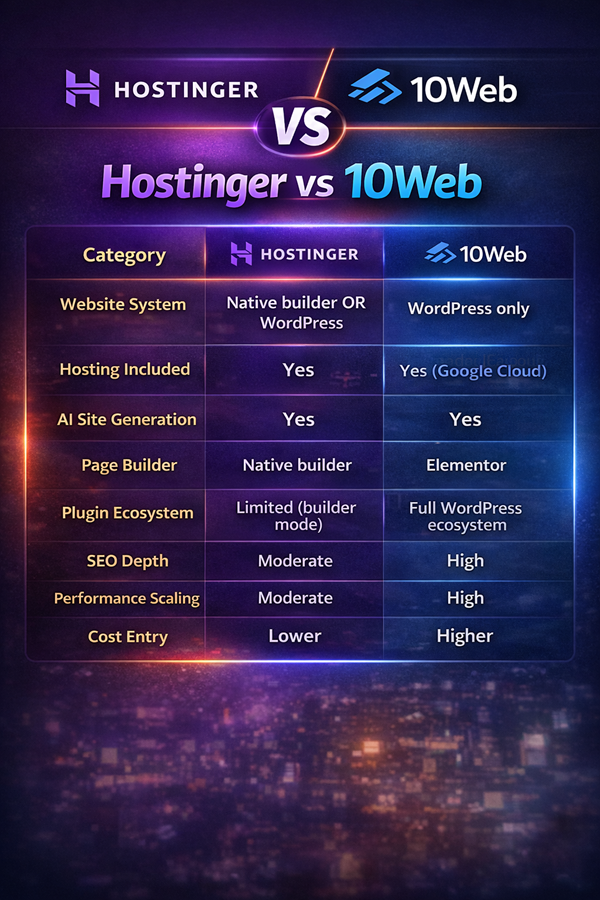
At a surface level, both platforms look similar. They generate sites with AI and include hosting. But beneath that surface, the systems behave differently.
Website System
- Hostinger: Native builder or WordPress
- 10Web: WordPress only
Hosting
- Hostinger: Included, shared or cloud depending on tier
- 10Web: Included, built on Google Cloud
Page Builder
- Hostinger: Native builder interface
- 10Web: Elementor inside WordPress
Plugin Ecosystem
- Hostinger (builder mode): Limited
- 10Web: Full WordPress plugin ecosystem
SEO Depth
- Hostinger: Moderate
- 10Web: High
Performance Scaling
- Hostinger: Moderate
- 10Web: High
Cost Entry
- Hostinger: Lower
- 10Web: Higher
These differences are not cosmetic. They influence what your site can become over time.
Scalability and Infrastructure
Scalability is where long-term decisions show up. Many businesses don’t think about infrastructure until traffic increases. By then, switching platforms becomes painful.
Hostinger’s entry plans rely on shared hosting, with cloud upgrades available on higher tiers. For brochure sites, local businesses, and moderate traffic levels, performance is typically stable. If your growth expectations are measured and predictable, this may be entirely sufficient.
However, shared environments naturally limit resource allocation. As traffic scales, infrastructure constraints can appear sooner than expected.
10Web runs on Google Cloud infrastructure and integrates performance optimization into the system. Built-in caching, image compression, and performance tuning are not optional add-ons. They are part of the environment.
If your strategy includes:
- Long-form content publishing
- Aggressive SEO growth
- Ecommerce expansion
- Higher traffic volume
Then infrastructure becomes a strategic asset, not just a background service.
Hostinger supports growth. 10Web is architected around it.
SEO Control and Technical Flexibility
SEO is often misunderstood as content alone. In reality, it is structural. URL management, schema markup, redirects, technical configuration, and plugin flexibility all matter.
Hostinger in native builder mode provides essential SEO controls. You can manage meta titles, descriptions, and sitemaps. For many small businesses, that is enough.
If you run WordPress on Hostinger, you gain full plugin access, which expands your SEO capabilities significantly.
10Web operates entirely within WordPress. This provides access to:
- Advanced SEO plugins
- Schema implementation
- Redirect management
- Structured data customization
- Technical SEO configuration
If SEO is a core growth engine rather than a side benefit, WordPress-based architecture generally provides more depth.
This is less about AI-generated content and more about long-term structural control.
AI Capabilities Compared
Both platforms use AI for site generation, but their priorities differ.
Hostinger AI focuses on rapid setup. It generates layouts and content quickly, making it efficient for business websites that need to go live without technical overhead.
10Web AI integrates into WordPress and Elementor. It can recreate existing websites, generate more complex layouts, and operate within a broader structural framework.
In simple terms:
- Hostinger prioritizes speed and simplicity
- 10Web prioritizes automation within a flexible system
Neither is inherently better. The choice depends on your growth expectations.
Pricing and Cost Structure
Cost is often the deciding factor, especially in early stages.
Hostinger typically ranges from approximately $3 to $12 per month at entry level. This makes it one of the more accessible hosting-plus-builder options available.
10Web generally ranges from approximately $10 to $30+ per month, reflecting its Google Cloud infrastructure and WordPress automation stack.
If immediate affordability is critical, Hostinger has the advantage.
If you view infrastructure as a long-term investment in scalability and SEO flexibility, 10Web may justify the higher monthly cost.
Who Should Choose Hostinger
Choose Hostinger if:
- You want the lowest entry cost
- You prefer simplicity over backend control
- You do not want WordPress complexity
- Your site will remain small to mid-sized
- You prioritize speed of launch over deep customization
Hostinger works well for business owners who want predictability and minimal technical involvement.
Who Should Choose 10Web
Choose 10Web if:
- You want full WordPress flexibility
- SEO is central to your strategy
- You expect traffic growth
- You need plugin ecosystem access
- You care about infrastructure-level performance
10Web aligns better with businesses planning for expansion, technical SEO depth, and higher traffic ceilings.
Final Strategic Recommendation
This comparison is not about which AI tool is more impressive. It is about architecture and long-term alignment.
Hostinger is a streamlined business website platform. It lowers cost and removes complexity. For many small businesses, that is the right decision.
10Web is a growth-oriented WordPress infrastructure system. It automates setup while preserving technical control and scalability.
If your goal is to launch quickly and keep things simple, Hostinger is practical.
If your goal is to build something that can expand, scale, and adapt without platform constraints, 10Web is structurally stronger.
The right decision depends less on today’s setup speed and more on where you expect your business to be two years from now.