Best AI Website Builder for Small Business: A Practical Evaluation
Best AI Website Builder for Small Business
Choosing the best AI website builder for small business is not about finding the most advanced platform.
It is about finding the right balance between speed, simplicity, control, and long-term flexibility.
AI builders promise instant websites. What they actually provide is structured acceleration. They remove blank-page friction, generate layouts, suggest copy, and simplify design decisions. What they do not remove is the need for review, editing, and strategic thinking.
If you are new to how these tools work, start with the AI Website Builder Guide: How It Works and What to Look For
https://ai.salesmarket.com/ai-website-builder-guide.html
That guide explains how AI builders generate content and structure, and where automation stops.
This article focuses specifically on small business decision-making.
What Small Businesses Actually Need
Most small businesses do not need complex architecture or custom frameworks.
They need:
- A clear homepage
- Service or product pages
- Contact forms and lead capture
- Basic SEO controls
- Mobile responsiveness
- Fast load speed
The best AI website builder for small business should make these outcomes easy.
Speed matters. But so does flexibility.
A platform that launches quickly but cannot scale becomes a liability later. A platform that is too flexible can recreate the complexity AI was supposed to eliminate.
The right tool sits in the middle.
How I’m Evaluating “Best”
To avoid hype, this comparison focuses on practical factors.
Setup Speed
How quickly can you go from zero to a live website?
Editing Simplicity
After AI generates the site, how easy is it to change text, layout, images, and sections?
Design Flexibility
Can the site grow with your business, or does it feel locked in?
SEO and Performance Controls
Can you edit titles, meta descriptions, URLs, and on-page structure?
Long-Term Cost
What happens after introductory pricing? Does scaling increase costs significantly?
These criteria matter more than marketing claims.
Wix AI – Most Balanced for Growth
Wix integrates AI directly into its onboarding flow. It asks structured questions about your business and generates layout, copy suggestions, and design direction based on your answers.
From a small business perspective, that reduces friction immediately.
Where Wix Performs Well
- Strong AI-assisted setup
- Full drag-and-drop editing
- Large app marketplace
- Solid SEO controls
- Ecommerce capability
Where You Need to Be Careful
- Customization can become overwhelming
- Apps increase monthly costs
- Over-editing can hurt design consistency
If you expect your business to grow, Wix is often the most balanced choice. You can start with a simple service website and later add bookings, ecommerce, memberships, or automation without switching platforms.
For long-term flexibility, that matters.
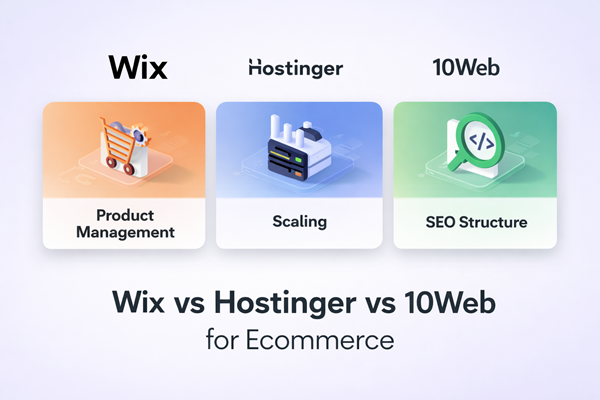
Hostinger AI Website Builder – Simplest and Most Budget-Friendly
Hostinger’s AI builder focuses on speed and simplicity. The setup flow generates a clean, functional website quickly with fewer customization variables.
For many small businesses, that is an advantage.
Where Hostinger Performs Well
- Lower entry pricing
- Fast AI generation
- Simple editing interface
- Clean layouts
Where Limitations Appear
- Fewer advanced design controls
- Smaller app ecosystem
- Less scalability compared to larger platforms
If you are launching a straightforward service business site and want minimal complexity, Hostinger can be more than enough.
It reduces decision fatigue. It is harder to overcomplicate things.
Squarespace – Design-Forward Option
Squarespace integrates AI into onboarding but remains template-driven at its core. Its strength is structured, visually cohesive design.
For brand-focused businesses, that can be decisive.
Where Squarespace Performs Well
- Polished templates
- Strong ecommerce tools
- Cohesive visual structure
- Built-in performance reliability
Where Friction Can Appear
- Less layout freedom than Wix
- Design changes require understanding section logic
- Mid-to-upper pricing range
If visual presentation is central to your positioning—restaurants, creative professionals, boutique brands—Squarespace often stands out.
Cost Considerations for Small Businesses
Short-term pricing and long-term pricing are rarely the same.
Many AI website builders promote low introductory rates. What matters more:
- Renewal pricing
- Ecommerce fees
- App subscriptions
- Transaction fees
- Upgrade requirements for advanced features
The cheapest builder is not always the most affordable over time.
The best AI website builder for small business is the one that does not force a rebuild in 18 months.
Common Mistakes Small Business Owners Make
Choosing Based Only on Price
Low monthly fees can lead to limitations that require migration later.
Overvaluing Automation
AI accelerates structure, but it does not replace strategy.
Ignoring Scalability
A five-page website today may become a content hub tomorrow.
Over-Customizing Too Early
Complexity defeats the purpose of using AI.
The goal is balance.
Which One Is Actually “Best”?
If you want maximum flexibility and long-term growth potential, Wix is often the strongest option.
If you want the simplest path to launch at the lowest cost, Hostinger makes sense.
If design consistency and brand aesthetics matter most, Squarespace is compelling.
There is no universal winner.
There is alignment between your business model and the platform’s strengths.
Final Take
Most small businesses do not need custom development.
They need:
- A clean homepage
- Clear services
- Strong calls to action
- Basic SEO structure
- Mobile performance
AI website builders make that achievable without hiring a developer.
The best AI website builder for small business is the one that:
- Launches you quickly
- Does not overwhelm you
- Scales when needed
- Fits your budget long-term
Choose based on where your business is going—not just where it is today.