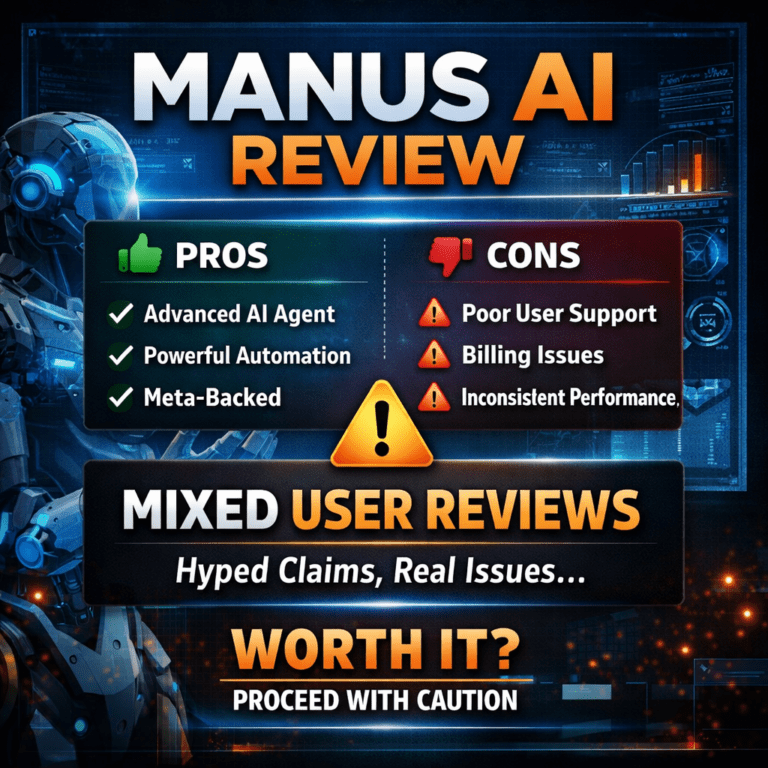
Manus AI Review: Not Ready for Primetime

Manus AI presents itself as a powerful AI system capable of handling publishing, web creation, and content production. On the surface, the capability appears strong.
But after using it for real projects — not test prompts — the experience revealed a pattern. The system shows potential. The execution, particularly under a credit-based model, makes sustained production work difficult.
This review reflects direct use across multiple workflows, including eBook publishing, web app development, and structured webpage generation. Some tasks worked. Others exposed meaningful friction.
The Credit Model Creates Immediate Friction
Manus AI operates on a credit-based pricing system. That alone is not unusual in the AI space.
The issue is how quickly credits are consumed during normal experimentation.
AI systems require iteration. You test prompts. You refine output. You correct formatting. That learning curve is expected.
But when:
- Basic experimentation drains credits rapidly.
- Multiple revisions are required to reach usable output.
- Troubleshooting consumes paid usage.
Users begin managing cost instead of exploring capability.
That shift changes the experience. Instead of asking, “What can this do?” the question becomes, “Is this worth using credits on?”
For a system that depends on experimentation to unlock value, that friction matters.
Not Ready for Primetime Across Workflows
My first serious test involved generating ready-to-upload eBooks for Google Play Books. The requirements were straightforward:
- Clean document formatting.
- A functional table of contents.
- Reliable internal and external linking.
- Output suitable for direct publishing.
After nine drafts, I still did not have a file that met publishing standards without manual correction.
Internal links were inconsistent. The table of contents required rework. External links were unreliable. I ultimately had to paste the content into Google Docs and perform significant formatting changes myself.
At that point, the efficiency benefit was gone.
Compounding the frustration was credit consumption. Each revision reduced available usage. By the time multiple drafts were complete, most credits had been used — without a finished product.
I stepped away from the eBook workflow inside Manus.
Next, I attempted to build a simple web application. The idea was not complex. But the process of structuring the foundation consumed remaining credits before the application was fully defined. I never reached a stable starting point.
Eventually, I moved the project to AI Studio, where I was able to proceed more effectively.
This was not a one-off issue. It was a pattern.
- Iteration required credits.
- Credits ran out before stability was achieved.
- Production reliability was inconsistent.
Where Manus AI Performed Well
To be fair, not every use case failed.
I requested a structured webpage that organized eBook titles and links into separate pages. This was a more contained task with limited formatting complexity.
It worked well.
The output required minimal correction and functioned properly. I used it successfully for two separate eBook series.
This suggests that Manus AI performs better when tasks are:
- Clearly defined.
- Structurally contained.
- Less dependent on precision publishing standards.
The system has capability. The consistency is uneven.
Conclusion
Manus AI shows real technical potential. In contained environments, it can produce useful results.
But across multiple real-world workflows — publishing, app development, and iterative refinement — the pattern was clear: meaningful output required repeated attempts, and repeated attempts consumed credits quickly. In some cases, credits ran out before a usable foundation was even in place.
That is not just a pricing issue. It is an adoption issue.
When users are still trying to understand how to make a system work — and run out of runway in the process — the platform becomes difficult to trust for production-level use.
Manus AI may continue to improve. The underlying technology is capable.
Right now, however, it feels like a tool you experiment with — not one you depend on.
Until experimentation stops feeling expensive, it won’t feel ready for primetime.
For a full technical overview, see our complete guide to what Manus AI actually is:
https://ai.salesmarket.com/what-manus-ai-actually-is.html