How Manus AI Actually Works (Behind the Autonomous Agent Model)
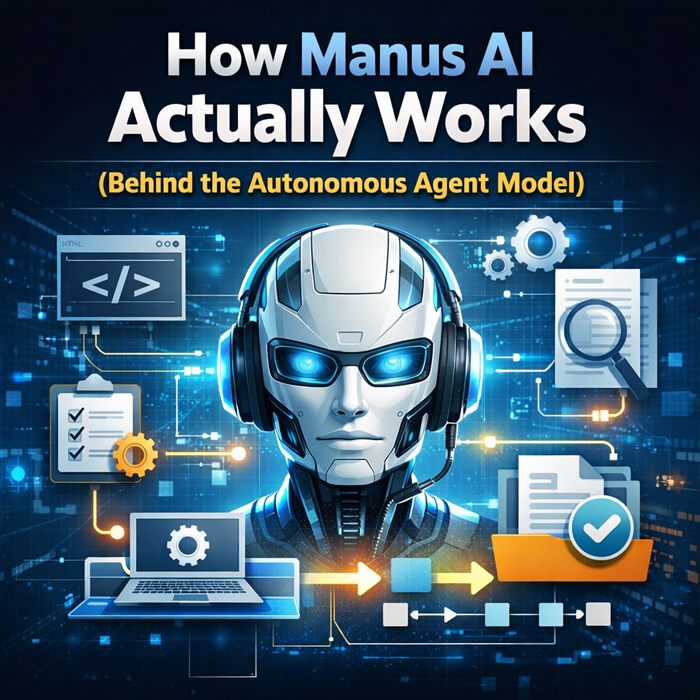
Manus AI is often described as an “autonomous AI agent,” but that phrase gets thrown around loosely. To understand whether the platform lives up to its positioning, you have to separate marketing language from system mechanics.
If you are unfamiliar with the broader platform, start with our breakdown of what Manus AI actually is. This article focuses specifically on how the agent model functions behind the scenes.
What Makes Manus AI Different from a Chatbot
Traditional AI chat systems operate in a request-response format. You ask a question. The model generates a reply. The interaction ends unless you prompt again.
Manus AI attempts something structurally different. Instead of generating one output at a time, it aims to:
- Interpret a goal
- Break the goal into steps
- Execute those steps using tools
- Verify or revise outputs
- Deliver a final structured result
This goal-oriented execution layer is what defines it as an “agent.”
Step 1: Goal Interpretation
Every task begins with user input — but unlike simple prompt systems, the agent attempts to interpret the broader objective rather than just produce text.
For example:
“Build a simple landing page and prepare it for email capture.”
Instead of outputting HTML only, the system may attempt to:
- Plan page structure
- Generate copy
- Create layout code
- Suggest deployment options
- Integrate form handling logic
This interpretation phase is essentially task planning.
The reliability of this stage depends heavily on how clearly the objective is defined. Ambiguity at the prompt level often leads to fragmented execution.
Step 2: Task Decomposition
Once the goal is interpreted, Manus AI reportedly breaks the objective into smaller sub-tasks.
This decomposition layer may include:
- Research tasks
- Code generation
- Content writing
- File structuring
- API interaction
- Data extraction
Each sub-task can be assigned to an internal sub-agent or tool handler.
This layered execution approach is what differentiates an agent from a simple language model interface.
However, complexity increases the risk of cascading errors — if one sub-task fails or generates flawed output, downstream results may inherit those issues.
Step 3: Tool Invocation
Manus AI’s agent model integrates tool usage. This can include:
- Code execution environments
- Web browsing modules
- File handling
- Data parsing
- Structured document generation
Rather than only “predicting text,” the system attempts to:
- Run scripts
- Access structured information
- Compile outputs into deliverables
This is where autonomous AI platforms tend to diverge from standard chatbot experiences.
The effectiveness of this stage depends on:
- Tool stability
- Error handling systems
- Runtime limits
- Permission scope
If tool invocation fails, the agent may stall or loop.
Step 4: Iteration and Self-Correction
Some autonomous agents attempt internal verification loops.
This means the system may:
- Review its own output
- Compare results against task criteria
- Adjust formatting
- Rerun components
In theory, this creates refinement without user intervention.
In practice, iteration sometimes produces:
- Increased credit consumption
- Repeated minor adjustments
- Unnecessary redundancy
Autonomous iteration improves polish but increases computational cost.
Step 5: Output Packaging
Finally, Manus AI compiles outputs into structured deliverables.
This could include:
- Completed code files
- Structured business documents
- Research reports
- Marketing drafts
- Workflow systems
The presentation layer often feels more complete than traditional chatbot responses because the agent attempts to package rather than simply reply.
The success of this stage depends on how cleanly earlier steps executed.
If decomposition or tool execution failed, the final output may appear complete but contain logical gaps.
Memory and Session Continuity
One defining feature of agent-based systems is contextual continuity.
Instead of treating each interaction as isolated, the system attempts to:
- Remember project context
- Continue long workflows
- Track prior outputs
This supports extended projects such as:
- Website building
- Marketing funnel development
- Automated research pipelines
However, memory systems must balance:
- Storage limits
- Session expiration
- Context overflow
Large or complex workflows can degrade performance if context handling becomes inefficient.
Where the Agent Model Breaks Down
Understanding how the system works also means understanding its failure points.
Common structural risks include:
Over-Autonomy Assumption
Users may assume the system can handle multi-layer business logic without supervision. In reality, autonomous planning is probabilistic, not strategic.
Cascading Error Chains
If a sub-agent produces flawed data, downstream steps inherit that flaw unless explicitly corrected.
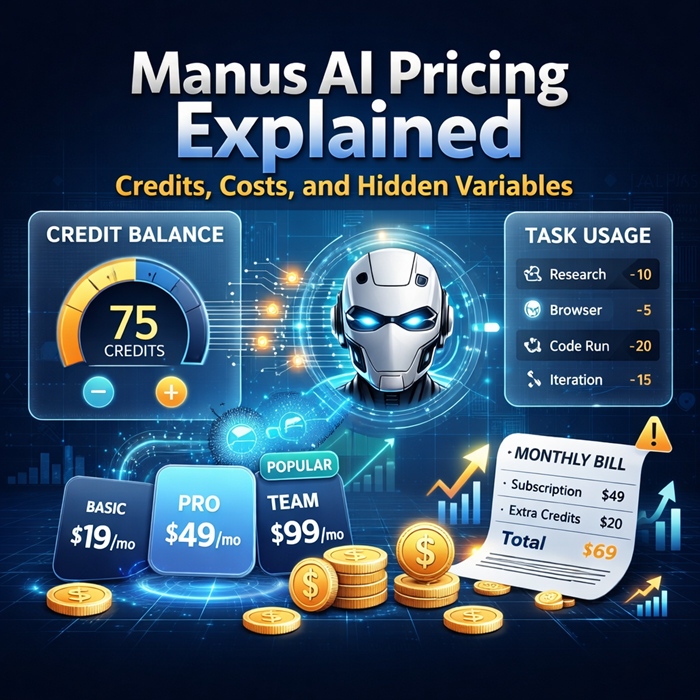
Credit Consumption and Iteration Loops
Autonomous iteration can consume credits faster than manual prompting.
Tool Dependency Fragility
If the system relies on external modules (browsers, parsers, runtime environments), instability in any component affects overall reliability.
Agent-based architecture is powerful — but complexity introduces more failure points than single-response AI systems.
Autonomous vs Assisted Execution
It is more accurate to describe Manus AI as a semi-autonomous execution environment.
The system still benefits significantly from:
- Clear objectives
- Constrained task scopes
- Explicit output requirements
- Step-by-step validation
Users who treat it as a fully independent business operator often encounter friction.
Users who treat it as an advanced execution assistant generally experience more stable outcomes.
How Manus AI’s Agent Model Compares to Standard AI Tools
Standard LLM tools:
- Generate text
- Respond to prompts
- Require human orchestration
Agent-based systems like Manus AI attempt to:
- Plan workflows
- Execute multi-step tasks
- Integrate tools
- Package outputs
This structural shift represents an evolution in AI usage — but not a replacement for human oversight.
The Bottom Line: How Manus AI Actually Works
At its core, Manus AI operates through:
- Goal interpretation
- Task decomposition
- Tool invocation
- Iteration and refinement
- Output compilation
It is not magic. It is layered orchestration built on top of language model reasoning and tool execution environments.
Understanding the mechanics behind the system helps clarify where expectations should be calibrated.
Autonomous AI agents can accelerate execution. They cannot replace strategic thinking, oversight, or quality control.