Squarespace AI Website Builder Review: Features, Pricing, and Real Limitations
Introduction: Where Squarespace AI Fits in the Bigger Picture
Before evaluating any individual AI builder, it helps to understand how these systems are structured and what they automate versus what they do not. If you have not yet reviewed the foundational framework, start with our guide on AI Website Builders. That context makes it easier to separate marketing claims from actual capability.
Squarespace has integrated artificial intelligence directly into its website builder rather than releasing a standalone AI-only product. The result is an experience that feels familiar but accelerated. This review examines what Squarespace AI genuinely improves, where it still requires manual input, and who should realistically consider it.
Key points you should understand upfront:
- Squarespace AI enhances the existing builder rather than replacing it with automation.
- The platform prioritizes structured design and visual polish over deep technical customization.
- AI assistance focuses on setup speed and content drafting, not strategic website planning.
What Squarespace AI Actually Is
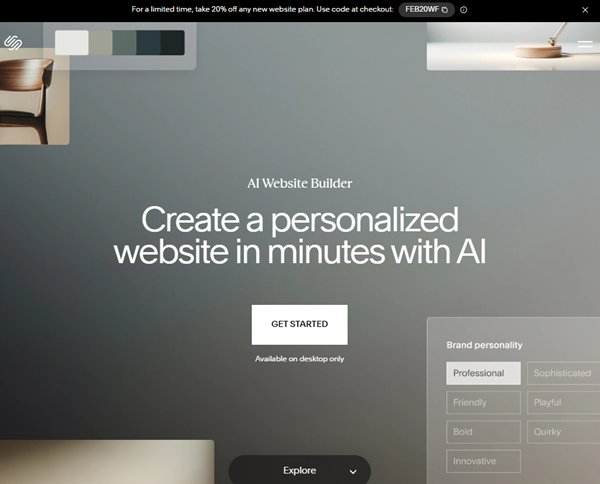
Squarespace integrates AI through guided onboarding and content generation tools built directly into its platform. Instead of generating a complete autonomous website from a single prompt, it uses structured inputs to assemble layouts, copy drafts, and visual elements.
The AI component primarily appears during setup through its Blueprint-style onboarding flow. Users answer questions about business type, goals, and aesthetic preferences, and the system generates a structured starting layout. From there, you move into the standard editor environment.
Important structural realities include:
- The AI creates an organized draft site, but it does not build a fully customized brand strategy.
- The generated layout follows Squarespace’s design system rules, which limits radical deviation.
- The editing experience remains hands-on and guided rather than automated.
Setup Experience and Initial Build Speed
Squarespace AI significantly reduces blank-page friction during initial setup. Within minutes, you receive a pre-structured homepage, navigation menu, and relevant sections tailored to your industry category.
However, the system does not eliminate decision-making. You still need to refine messaging, adjust imagery, and validate structure against your business goals. The AI speeds the start, but it does not replace strategic thinking.
During hands-on testing, several patterns became clear:
- The onboarding questions meaningfully influence layout composition and page structure.
- Industry selection impacts typography, imagery tone, and content emphasis.
- Manual edits are still required to align the site with real positioning and offers.
Overall, setup speed is strong, but meaningful customization still demands attention.
Design Quality and Customization Control
One of Squarespace’s historical strengths is design consistency, and the AI layer reinforces that advantage. The system produces visually balanced layouts with clean typography and structured spacing from the start.
Because the platform operates within a design system, users benefit from guardrails that prevent major aesthetic mistakes. At the same time, those guardrails limit extreme customization flexibility.
Customization realities include:
- Global style controls make color and font changes efficient and cohesive.
- Section-based editing simplifies layout modification without breaking design integrity.
- Deep structural customization is more constrained compared to platforms like WordPress.
For users prioritizing polished design without developer involvement, this balance is generally beneficial.
AI Content Generation and Practical Use
Squarespace AI includes built-in text generation for headlines, product descriptions, and page sections. The output quality is typically clean and grammatically solid, but it tends to default to safe, generic marketing language.
In practical use, the AI performs best as a drafting assistant rather than a final copy solution. It reduces friction but does not eliminate the need for brand voice refinement.
Real-world content observations:
- The AI provides structured paragraphs that fit layout sections correctly.
- Messaging often requires personalization to avoid sounding interchangeable.
- Strategic positioning, differentiation, and storytelling still require manual editing.
Used properly, it accelerates production without replacing thoughtful writing.
Ecommerce Capabilities and Business Use Cases
Squarespace includes built-in ecommerce tools across its higher-tier plans, allowing users to sell physical products, digital downloads, and subscriptions. The AI assists primarily at the content layer rather than inventory or pricing logic.
For small to mid-sized stores, the integration feels streamlined. However, high-scale ecommerce businesses may require more advanced backend flexibility offered by platforms like Shopify.
Operational considerations include:
- Product pages can be generated quickly with AI-assisted descriptions.
- Checkout flows are integrated and mobile optimized by default.
- Advanced customization options are more limited than specialized ecommerce systems.
For service providers and smaller product catalogs, the capabilities are typically sufficient.
SEO Structure and Performance
Squarespace provides a solid technical SEO foundation. Users can edit meta titles, descriptions, and URLs while benefiting from automatic mobile responsiveness and SSL security.
The AI layer does not replace SEO strategy. It can generate keyword-aware content if prompted carefully, but it does not perform keyword research or internal link planning automatically.
From a performance perspective:
- Page speed is generally strong due to optimized templates.
- URL structures are clean and editable.
- Strategic content architecture must still be manually implemented.
The platform supports SEO effectively, but execution remains user-dependent.
Pricing and Value Structure
🧾 Squarespace Pricing & Plan Comparison (2026)
| Feature / Plan | Basic | Core | Plus | Advanced |
|---|---|---|---|---|
| Annual Price (per month) | ~$16/mo | ~$23/mo | ~$39/mo | ~$99/mo |
| Monthly Price (pay month-to-month) | Higher than annual | Higher than annual | Higher than annual | Higher than annual |
| Free 14-day trial | ✔ | ✔ | ✔ | ✔ |
| Custom domain included (1st year) | ✔ | ✔ | ✔ | ✔ |
| AI design & content tools | ✔ | ✔ | ✔ | ✔ |
| Website builder & templates | ✔ | ✔ | ✔ | ✔ |
| Blogging & basic marketing tools | ✔ | ✔ | ✔ | ✔ |
| Ecommerce capabilities | Limited* | ✔ | ✔ | ✔ |
| Squarespace Commerce fees | Standard payment fees + 3%** | Standard payment fees + 3%** | Lower fees / 0% transaction*** | Lowest payment fees*** |
| Video storage & hours | Basic | Basic | Expanded | Expanded |
| Advanced eCommerce features | No | Limited | Yes | Yes |
| Abandoned cart recovery | No | No | No | ✔ |
| Subscriptions & digital products | No | No | Some | ✔ |
| Advanced shipping & discounts | No | No | Limited | ✔ |
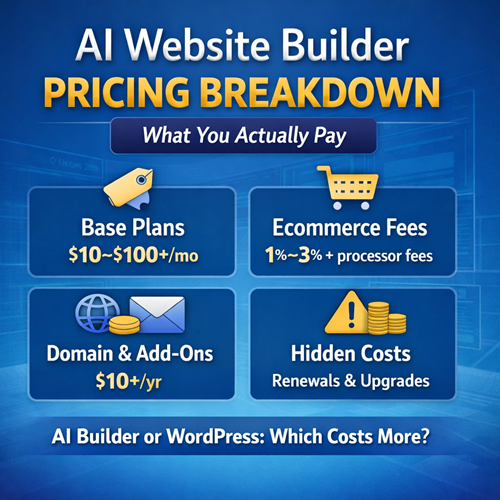
Squarespace operates on fixed subscription tiers without AI credit systems or usage-based billing complexity. This predictability can be advantageous for small businesses managing recurring expenses.
While not the cheapest builder on the market, the pricing reflects bundled hosting, design infrastructure, and integrated tools. There are no hidden AI usage fees layered on top of standard plans.
Key pricing characteristics:
- Plans scale from basic website functionality to advanced commerce.
- AI features are included rather than sold separately.
- Long-term costs remain stable and predictable.
For business owners prioritizing budgeting clarity, this structure reduces uncertainty.
Final Verdict: Who Should Use Squarespace AI
Squarespace AI is best described as an intelligent acceleration layer inside a structured website builder. It speeds up site creation and content drafting while preserving design consistency and platform stability.
It does not eliminate the need for positioning, editing, or SEO planning. Users who expect full automation may feel underwhelmed, but those who want a guided, polished starting point will likely appreciate the experience.
This platform is most suitable for:
- Freelancers and consultants who need a fast professional presence.
- Service-based businesses requiring clean design without developer involvement.
- Small ecommerce brands operating within structured product catalogs.
It is less suited for:
- Developers seeking full backend customization control.
- Businesses requiring complex integrations or highly dynamic web applications.
Squarespace AI enhances efficiency but does not replace strategic decision-making.