
Manus AI Pricing Explained: Credits, Costs, and Hidden Variables
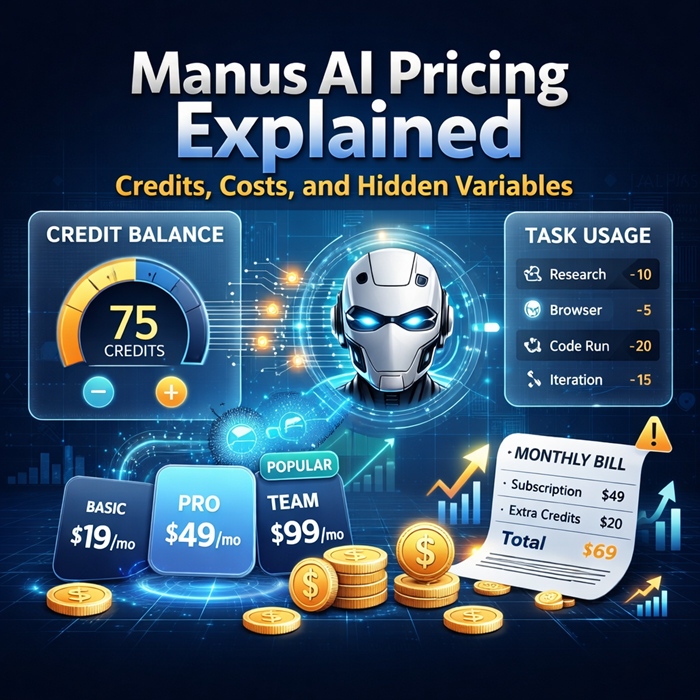
Understanding how Manus AI works technically is one thing. Understanding how you are charged for using it is another.
Before evaluating subscription value, start with What Manus AI Actually Is. That foundational guide explains the platform’s architecture and positioning, which helps contextualize its pricing structure.
This article focuses specifically on how the credit system works, where costs accumulate, and what users often overlook.
How the Manus AI Pricing Model Works
Manus AI does not operate purely on a flat monthly usage model. Instead, most tiers rely on:
- Subscription access
- Credit allocation
- Consumption-based execution
Credits function as computational fuel. Each task performed by the agent consumes credits depending on complexity, tool usage, and runtime duration.
This is fundamentally different from traditional SaaS platforms that provide unlimited feature access within a tier.
What Consumes Credits
Credits are typically consumed when the system:
- Runs multi-step workflows
- Executes code
- Invokes browser tools
- Iterates for refinement
- Processes extended research tasks
The more autonomous the task, the higher the computational footprint.
This means a simple text-generation request may cost relatively little, while a fully automated workflow could deplete credits rapidly.
The Hidden Variable: Iteration
One structural feature of autonomous agents is internal iteration.
If the system:
- Revises its own output
- Re-runs sub-agents
- Attempts corrections
- Refines formatting
Each of these actions can incrementally consume credits.
From a user perspective, this can feel invisible. The agent appears to be “thinking,” but that thinking translates into computational cost.
Over time, iteration-heavy tasks can drain monthly allocations faster than expected.
Complexity Scaling
Credit consumption increases with:
- Task ambiguity
- Multi-tool orchestration
- Long-context memory retention
- Large output generation
For example:
“Write a landing page” is lower cost than
“Research market demand, generate competitor analysis, design a landing page, write email automation, and package deployment files.”
Autonomous expansion of scope increases consumption.
This is one reason structured prompts tend to be more cost-efficient.
Subscription + Credit Hybrid Model
Some users misunderstand the pricing structure because access and usage are separate variables.
You may pay:
- A monthly subscription fee
- Plus consume credits within that tier
If credits are exhausted:
- You may need to purchase additional credits
- Or upgrade tiers
This hybrid model creates variability in effective monthly cost.
Flat-fee expectations can lead to miscalculation.
Where Users Encounter Friction
Common friction points reported across credit-based AI platforms include:
- Unexpected depletion
- Unclear credit tracking
- High consumption during experimentation
- Cost unpredictability for business scaling
Autonomous systems amplify these variables because execution depth is not always linear.
A single task may branch internally.
Is the Pricing Model Inherently Problematic?
Not necessarily.
Credit-based models allow:
- Scalable infrastructure
- Resource allocation proportional to demand
- Cost alignment with computational intensity
However, they require users to:
- Understand consumption patterns
- Monitor usage actively
- Structure tasks efficiently
Without this awareness, cost perception can become negative.
How to Reduce Credit Waste
Users who report more stable experiences often:
- Break complex goals into phases
- Provide highly specific task instructions
- Avoid open-ended iteration
- Review intermediate outputs before expansion
Autonomy performs best when guided by structured oversight.
Treating the system as an execution assistant rather than an independent operator often improves cost control.
The Bottom Line on Manus AI Pricing
Manus AI’s pricing reflects its architectural ambition.
Because the platform attempts multi-step autonomous execution, it must meter computational usage. That creates variability.
Understanding:
- What consumes credits
- How iteration affects cost
- How complexity scales
is essential before using the system for business-critical workflows.
Autonomous agents may reduce manual labor — but they introduce computational economics that users must manage actively.