Manus AI vs ChatGPT: What’s Actually Different?
Manus AI is often described as “more than a chatbot,” but that comparison usually stops at marketing language. To understand the difference, you need to look at execution architecture, workflow handling, and autonomy models.
If you’re new to the platform itself, begin with What Manus AI Actually Is. That foundational article explains how the agent model works before comparing it to traditional AI systems.
This article focuses on structural differences between Manus AI and ChatGPT.
Core Architectural Difference
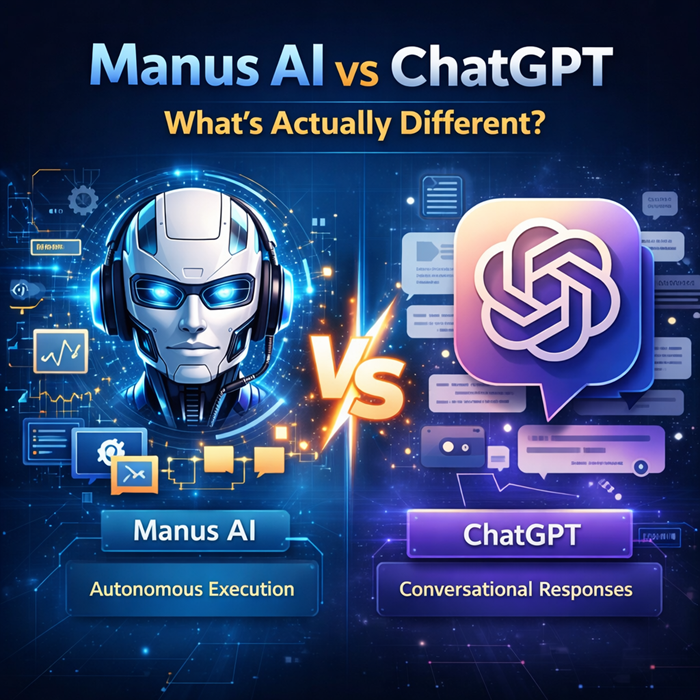
ChatGPT operates primarily as a conversational large language model interface. You provide input, it generates output.
Manus AI attempts to function as an autonomous agent layer built on top of language model reasoning.
The distinction is not about intelligence level. It is about execution structure.
ChatGPT:
- Prompt → Response
- Human controls workflow
- Text generation focused
Manus AI:
- Goal → Decomposition → Tool execution → Output packaging
- System orchestrates steps
- Multi-layer task execution
The difference lies in orchestration.
Workflow Control
With ChatGPT, the user manages:
- Task sequencing
- Refinement
- Iteration
- File compilation
You act as the project manager.
With Manus AI, the system attempts to:
- Break down objectives
- Assign internal sub-tasks
- Execute multi-step processes
- Compile deliverables
This reduces manual orchestration but introduces dependency on system planning.
The tradeoff is control versus automation.
Tool Integration
ChatGPT (standard version) generates text but does not inherently execute tools unless connected to plugins, code interpreters, or browsing modules.
Manus AI is structured around tool invocation. It may:
- Execute code
- Access web data
- Compile structured files
- Run multi-step workflows
In theory, this reduces friction between idea and implementation.
In practice, tool invocation reliability determines outcome stability.
If tools fail or misinterpret instructions, output quality degrades.
Autonomy Level
ChatGPT is reactive. It responds.
Manus AI attempts proactive orchestration.
However, autonomy is bounded by:
- Prompt clarity
- System planning logic
- Tool accuracy
- Context retention limits
Neither system replaces strategic decision-making. The autonomy layer reduces manual prompting but does not eliminate oversight.
Cost Structure Differences
ChatGPT pricing is typically subscription-based with usage caps.
Manus AI uses a hybrid subscription + credit consumption model.
This creates variability in effective monthly cost for Manus AI users, especially when workflows are complex or iteration-heavy.
ChatGPT’s cost model tends to feel more predictable for content-focused tasks.
Manus AI’s cost structure reflects its computational ambition.
When ChatGPT May Be More Efficient
ChatGPT often performs well for:
- Content drafting
- Brainstorming
- Research summaries
- Strategy outlining
- Code generation (manual implementation)
It excels when the user prefers direct control over execution.
If you already manage workflows independently, ChatGPT may be sufficient.
When Manus AI May Offer Advantages
Manus AI may provide value when:
- Multi-step execution is required
- File packaging matters
- Research → compile → structure workflows are repetitive
- Automation reduces manual labor
The key advantage is reduced orchestration effort.
The risk is loss of granular control and credit unpredictability.
Reliability Considerations
ChatGPT’s simplicity makes it predictable.
Manus AI’s complexity increases potential failure points:
- Cascading task errors
- Tool instability
- Iteration loops
- Context overflow
The more layers added to a system, the more edge cases emerge.
Complexity increases power and fragility simultaneously.
Strategic Perspective
It is not accurate to frame Manus AI as “better” than ChatGPT.
They serve different workflow philosophies:
ChatGPT supports assisted intelligence.
Manus AI attempts semi-autonomous execution.
Choosing between them depends on:
- Desired level of oversight
- Budget sensitivity
- Workflow complexity
- Tolerance for system variability
Both tools rely on underlying language model reasoning. The differentiator is execution orchestration.
The Bottom Line
Manus AI differs from ChatGPT primarily in how it structures execution, not necessarily in raw intelligence.
ChatGPT places the human in charge of workflow.
Manus AI attempts to automate workflow management itself.
The practical question is not which tool is more advanced, but which model aligns better with how you prefer to operate.